

The supplement aisle, whether physical or digital, can feel like a maze with no exit. You know you want to live longer, feel sharper, and age on your own terms, but the options are endless and the advice is often contradictory. One influencer swears by NMN, another pushes resveratrol, and a third insists you need a 14-supplement stack just to get started. For health-conscious individuals in the EU, there’s an added layer: safety regulations, novel compound restrictions, and quality standards that genuinely matter. This guide cuts through the noise with a clear, science-based, step-by-step process to help you choose supplements that actually fit your biology and your goals.
Table of Contents
- Clarifying your supplement goals and laying a foundation
- Understanding regulations and supplement safety for EU residents
- The step-by-step process: Personalizing your supplement stack
- Troubleshooting, avoiding common mistakes, and ongoing verification
- The inconvenient truth about supplement selection for longevity
- Take the next step: Curated supplements and diagnostics
- Frequently asked questions
Key Takeaways
| Point | Details |
|---|---|
| Personalization is key | Use individual testing and EFSA guidelines to select supplements tailored to your health goals. |
| Safety first | Prioritize EU-compliant supplements and avoid novel or unapproved compounds for longevity. |
| Start small, verify progress | Introduce one supplement at a time and regularly test to ensure effectiveness and minimize risk. |
| Lifestyle trumps stacking | Supplements enhance, not replace, a strong foundation of diet, exercise, and sleep. |
Clarifying your supplement goals and laying a foundation
Before you spend a single euro on supplements, you need to know exactly what you’re trying to achieve. This sounds obvious, but most people skip this step entirely. They see a product trending online and buy it without asking: does this actually address something I need?
Start by identifying your core motivation. Are you focused on:
- Longevity and cellular aging (slowing biological age markers)
- Energy and mitochondrial function (fighting fatigue and low stamina)
- Immunity and inflammation (reducing chronic low-grade inflammation)
- Mental clarity and cognitive resilience (protecting memory and focus)
- Hormonal balance and stress regulation (managing cortisol, sleep quality)
Once you name your goal, assess your current baseline. Supplements are amplifiers, not replacements. If your sleep is broken, your diet is poor, or you’re chronically stressed, no supplement will compensate for that. Longevity expert insights consistently reinforce this: lifestyle and exercise sit at the top of the evidence pyramid. As one analysis notes, prioritizing lifestyle over supplements is backed by Tier 1 evidence, the highest quality available.
Document specific goals in writing. Are you trying to reverse a known deficiency? Improve a specific biomarker? Support recovery from illness? The more precise you are, the easier it becomes to evaluate whether a supplement is genuinely relevant.
“Supplements work best when they’re filling a real gap, not creating an imaginary one.”
Consider whether recent health changes, new medications, or a family history of certain conditions should factor into your choices. And if you’re unsure, a doctor or registered nutritionist is not a luxury. It’s a smart investment.
Pro Tip: Write down your top three health goals before researching any supplement. If a product doesn’t directly address at least one of them, put it back.
The step-by-step process: Personalizing your supplement stack
Knowing the rules and risks, you can now confidently move into personalized supplement selection. This is where strategy replaces guesswork.
-
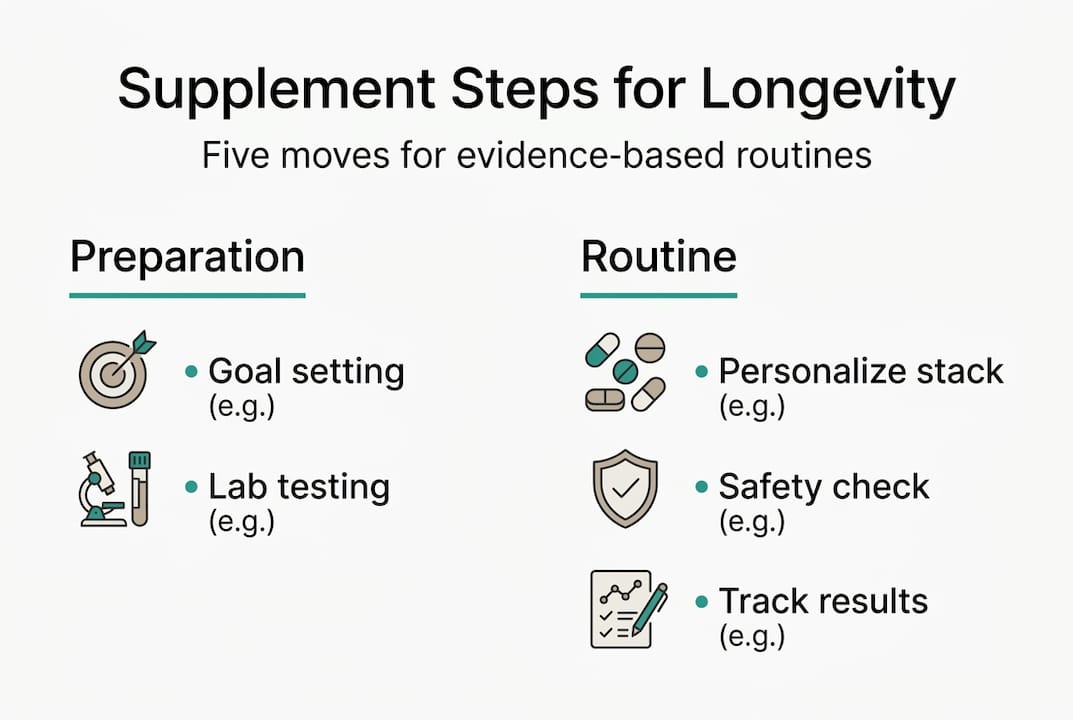
Review your lab values first. A blood test is your starting point, not a luxury. Deficiencies in vitamin D, B12, iron, magnesium, or omega-3s are common and measurable. Tracking vitamin levels before supplementing means you’re solving a real problem, not a hypothetical one.
-
Research only EFSA-approved ingredients. Once you know your gaps, cross-reference with approved compounds. Personalization via bloodwork, not hype is the only reliable method.
-
Evaluate options using a comparison framework. Not all forms of a nutrient are equal. Magnesium glycinate absorbs differently than magnesium oxide. Vitamin D3 outperforms D2 in most studies. Use evidence to choose the right form.
| Nutrient | Best-absorbed form | Evidence strength | Common use case |
|---|---|---|---|
| Vitamin D | D3 (cholecalciferol) | Strong | Bone, immunity, mood |
| Magnesium | Glycinate or malate | Moderate-strong | Sleep, muscle, stress |
| Omega-3 | Triglyceride form | Strong | Cardiovascular, brain |
| Zinc | Picolinate or bisglycinate | Moderate | Immunity, skin, hormones |
| B12 | Methylcobalamin | Strong | Energy, nervous system |
-
Introduce one supplement at a time. Stacking multiple new supplements simultaneously makes it impossible to identify what’s working or causing side effects. Single-ingredient changes are the gold standard.
-
Retest every 3 to 6 months. Your biology changes. What you needed six months ago may no longer be a priority. Personalized DNA tests can also reveal genetic predispositions that inform long-term supplementation strategy.
Pro Tip: Run a baseline blood panel before starting any new supplement. It gives you a true before-and-after picture and removes all the guesswork.
Troubleshooting, avoiding common mistakes, and ongoing verification
With your stack tailored, it’s crucial to monitor, troubleshoot, and fine-tune for long-term gains. Even a well-designed supplement routine can go sideways without proper oversight.
The most common mistakes people make:
- Chasing trends instead of addressing actual deficiencies
- Using unapproved or novel compounds without understanding EU restrictions
- Ignoring drug-supplement interactions (especially relevant for anyone on medication)
- Skipping retesting and assuming a supplement is working based on feel alone
- Overloading the stack before individual effects are understood
As experts caution, broad stacks without testing or proper personalization are a recipe for wasted money at best, and adverse effects at worst.
Know when to pause, stop, or adjust:
- Pause if you notice new symptoms within 2 to 4 weeks of starting a supplement
- Stop if symptoms persist or worsen after pausing and reintroducing
- Adjust dose only incrementally, never in large jumps
- Consult your doctor before resuming if you experienced a significant reaction
“Small, steady adjustments beat dramatic overhauls every time. Your body needs time to adapt, and so does your data.”
Retesting lab values is non-negotiable. It’s the only objective way to confirm that a supplement is doing what you intended. Reviewing longevity best practices regularly keeps your approach grounded in current evidence rather than outdated assumptions.
Schedule a formal check-in with a healthcare provider at least twice a year. Bring your supplement list, your latest lab results, and any symptom notes. This turns supplementation from a solo experiment into a supervised, evolving health strategy.
Pro Tip: Keep a simple supplement log: date started, dose, any changes in energy, sleep, or digestion. Three months of notes is worth more than any marketing claim.
The inconvenient truth about supplement selection for longevity
Here’s what most supplement content won’t tell you: the majority of longevity supplement routines fail not because the products are bad, but because the approach is wrong from the start.
People chase miracle stacks assembled by influencers who have no idea what your bloodwork looks like. They skip the basics, sleep, movement, stress management, and expect a capsule to compensate. They add five new supplements at once and then wonder why they feel off.
The hard truth is that rigorous, boring, evidence-based personalization beats every trending stack. One well-chosen supplement that addresses a confirmed deficiency will outperform ten random additions every single time. We’ve seen this pattern repeatedly, and the honest longevity advice from leading experts confirms it.
Consistency and science should always come first. The most effective supplement routine is the one you can sustain, verify, and adjust over years, not weeks. That’s not a limitation. That’s how real longevity is built.
Take the next step: Curated supplements and diagnostics
You now have a structured, evidence-based path forward. The next move is putting it into action with tools you can actually trust.

Our BOOST 2.0 supplement is formulated with EFSA-compliant ingredients including creatine, taurine, lysine, and collagen, designed to support energy, muscle function, and cellular health. Browse our full range of individual supplements to match your specific lab-confirmed needs, or explore our premade longevity kits for a curated starting point. Pair any supplement routine with our comprehensive DNA and blood tests to ensure every choice is grounded in your actual biology, not guesswork.
Frequently asked questions
What is the safest way to start supplementing for longevity?
Begin with baseline lab testing, choose only EFSA-approved ingredients, and introduce one supplement at a time to monitor effects clearly.
Should I take a full ‘stack’ or focus on one supplement first?
Start with individual supplements based on confirmed needs. Broad stacks without testing make it impossible to track what’s working and increase the risk of interactions.
How do I know if a supplement brand is safe in the EU?
Check for EFSA approval, GMP certification, published third-party lab results, and a fully transparent ingredient list with declared dosages.
How often should I retest when taking new supplements?
Every 3 to 6 months is the standard recommendation, though your healthcare provider may suggest a different schedule based on your specific health profile.
Do I need professional guidance for supplement routines?
Professional guidance is strongly recommended, especially if you have pre-existing conditions, take medications, or are building a multi-supplement routine over the long term.
Recommended
- Unlocking Longevity 2024: Practical Tips and Routines for a Longer, He – LifeUnlocked
- Key Takeaways About Longevity: The Insights from longevity experts – LifeUnlocked
- Top Anti-Aging Nutrition Tips Backed by Science for 2026 – LifeUnlocked
- Aging Gracefully: A Comprehensive Guide to Optimal Healthspan – LifeUnlocked
- The Senior Client Superpower: How Training the 65+ Demographic Makes You a Better Trainer | TrainingPro
Podíl:
What is healthy aging? A complete guide to holistic longevity
Active longevity: holistic solutions for thriving well-being