

Normal blood tests may overlook micronutrient deficiencies that accelerate aging.
Optimizing vitamins beyond minimum standards, especially D, B12, B9, B6, and K2, supports longevity.
Personalized testing and targeted supplementation are essential for extending healthspan and preventing silent declines.
Your blood test says you’re ‘normal.’ But normal isn’t the same as optimal, and that gap could be quietly accelerating how fast you age. Emerging science on micronutrient allocation shows that optimizing vitamin levels beyond basic sufficiency is essential to prevent invisible deficiencies that accelerate aging. This article unpacks the real difference between avoiding deficiency and genuinely supporting a long, healthy life, which vitamins matter most, how to read your lab results like a biohacker, and what precision supplementation actually looks like in practice.
Table of Contents
- Why ‘normal’ isn’t optimal: The triage theory and invisible aging
- Which vitamins matter most for extended healthspan?
- From average to optimal: Interpreting lab ranges and setting real targets
- Biohacker’s approach: Personalization, testing, and precision optimization
- Nuances, controversies, and real-world longevity results
- Rethinking vitamin optimization: What most experts don’t tell you
- Take the next step toward your optimal health
- Frequently asked questions
Key Takeaways
| Point | Details |
|---|---|
| Normal isn’t always optimal | Aiming for optimal vitamin levels—not just normal—supports better longevity and healthspan. |
| Personalized testing is key | Regular blood tests and DNA insights allow you to tailor your nutrition for maximum benefit. |
| Crucial micronutrients | Vitamins D, B6, B9, B12, and K are especially important for slowing aging and boosting cellular resilience. |
| Beware subtle deficiencies | Invisible shortfalls may harm DNA repair and longevity even in the absence of obvious symptoms. |
| Strategic supplementation works | A targeted approach using supplements and diet is more effective than a generic multivitamin for most people. |
Why ‘normal’ isn’t optimal: The triage theory and invisible aging
Most people assume that if their doctor hasn’t flagged a deficiency, they’re fine. That assumption is one of the most common and costly mistakes in longevity optimization. Standard reference ranges are designed to prevent clinical disease, not to maximize healthspan. There’s a significant difference between those two goals.
The triage theory of micronutrient allocation offers a compelling explanation for why subclinical gaps matter so much. According to this framework, when your body faces a shortage of a key vitamin or mineral, it prioritizes short-term survival proteins over longevity proteins. In other words, your cells make triage decisions, keeping you alive today at the expense of DNA repair, cellular maintenance, and anti-aging processes that protect you decades from now.
This is what makes invisible deficiency so dangerous. You won’t feel it. Your energy might be fine, your bloodwork might look acceptable, and yet your body’s long-term repair machinery is quietly running on fumes.
“The triage theory reframes how we think about micronutrient gaps: it’s not just about avoiding disease today, it’s about protecting your future self from accelerated aging.”
Here’s what subclinical deficiency can silently affect:
- DNA repair capacity, increasing mutation risk over time
- Mitochondrial function, reducing cellular energy efficiency
- Immune regulation, making you more vulnerable to chronic inflammation
- Bone remodeling, setting the stage for fragility years later
- Neurological resilience, affecting mood, cognition, and long-term brain health
The insights from longevity experts consistently point to the same conclusion: waiting for symptoms before optimizing is waiting too long. The goal is to stay ahead of the curve, not react to it.
Now that you see why standard ranges aren’t always sufficient, let’s explore which vitamins make the greatest difference for longevity.
Which vitamins matter most for extended healthspan?
Not all vitamins are created equal when it comes to aging well. Some play such foundational roles in DNA repair, immune function, and cellular signaling that even mild, chronic shortfalls can quietly compress your healthspan.
The key vitamins for longevity include B6, B9 (folate), B12, D, and K. Optimal vitamin D levels, in particular, reduce systemic inflammation, support bone density, and lower the risk of cardiovascular and metabolic disease. These aren’t marginal benefits. They’re the difference between aging with vitality and aging with fragility.

The EU data makes this urgent. Up to 40% of Europeans are insufficient in vitamin D alone, with significant public health implications. And that’s just one nutrient.
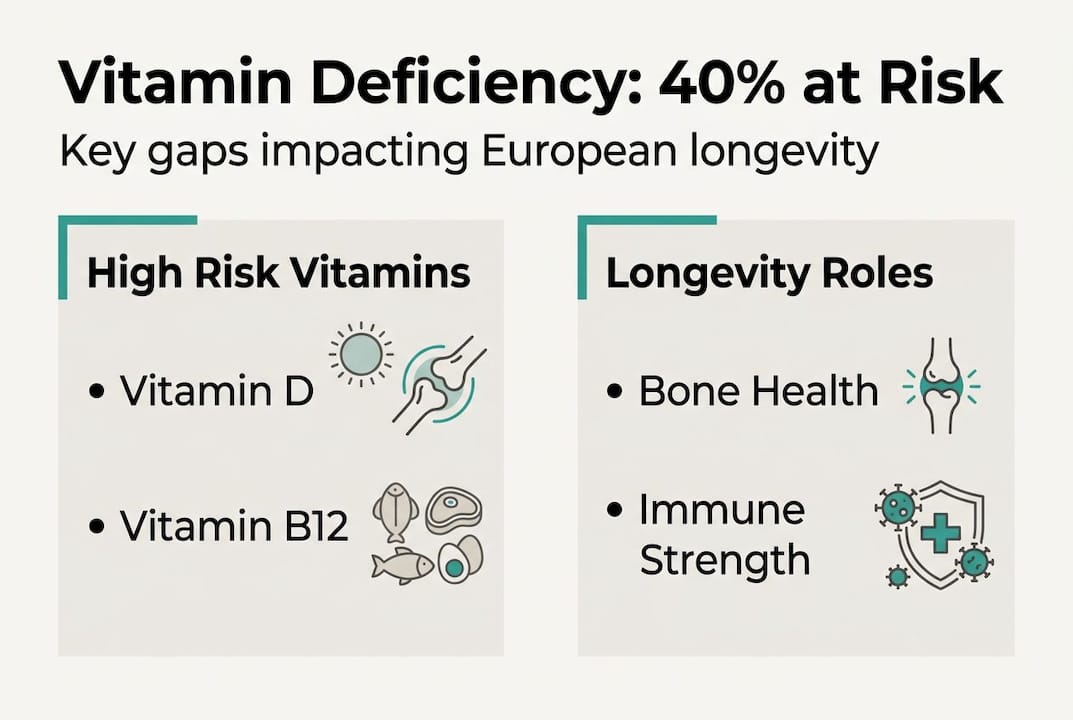
Key vitamins and their longevity roles:
| Vitamin | Primary longevity role | Common deficiency risk in EU |
|---|---|---|
| D | Bone health, immune regulation, inflammation control | Very high (especially northern climates) |
| B12 | Nerve function, DNA synthesis, red blood cell health | High in older adults and vegans |
| B9 (Folate) | DNA repair, methylation, cardiovascular protection | Moderate, higher in pregnant women |
| B6 | Neurotransmitter synthesis, immune support | Moderate, rises with age |
| K2 | Calcium regulation, arterial and bone health | Often overlooked, frequently low |
Chronic, mild deficiencies in these vitamins don’t announce themselves loudly. Instead, they chip away at your resilience over years and decades. Fatigue, brain fog, low mood, and subtle immune weakness are common early signals that most people attribute to stress or aging itself.
For anti-aging nutrition tips grounded in current evidence, the message is consistent: food first, but test to confirm. Even a varied, whole-food diet can leave gaps, especially for B12 and D in northern Europe. Your optimal healthspan guide starts with knowing where you actually stand.
From average to optimal: Interpreting lab ranges and setting real targets
Once you know which vitamins to focus on, it’s time to interpret your own results and set targets that actually promote longevity, not just avoid disease.
Here’s the core problem with standard lab ranges: they’re built to catch deficiency, not to support peak function. The optimal vitamin D range for longevity purposes is 30 to 50 ng/mL (75 to 125 nmol/L). Many EU labs flag anything above 20 ng/mL as acceptable. That gap between ‘acceptable’ and ‘optimal’ is where accelerated aging quietly lives.
Similarly, EU DRV and NRV guidelines are designed to prevent deficiency in the general population. They are minimum standards, not optimized targets for a biohacker aiming to extend healthspan by a decade or more.
Standard vs. optimal targets for key vitamins:
| Vitamin | EU lab ‘normal’ range | Longevity-focused target |
|---|---|---|
| D (25-OH) | >20 ng/mL (50 nmol/L) | 30-50 ng/mL (75-125 nmol/L) |
| B12 | >200 pg/mL | >400-600 pg/mL |
| Folate (B9) | >3 ng/mL | >10 ng/mL |
| K2 (MK-7) | Not routinely measured | Functional markers preferred |
When you speak with your practitioner, come prepared. Ask specifically for your numeric result, not just ‘normal’ or ‘low.’ Request a trend over time, not a single snapshot. And be willing to advocate for testing that goes beyond the minimum panel.
Pro Tip: If your vitamin D result is between 20 and 30 ng/mL, most labs will call it normal. Push for the higher end of the optimal range before winter, when sun exposure drops and levels fall further.
Tracking your levels over time is where the real insight lives. Tracking vitamin levels consistently is what separates reactive health management from proactive longevity strategy. If you haven’t run a full panel recently, a nutrition self-test is a practical starting point.
Biohacker’s approach: Personalization, testing, and precision optimization
Armed with the right targets and science, here’s how to put this framework into action for long-lasting results.
Precision nutrition starts with data. Blood markers and targeted supplementation, combined with diets rich in plants, nuts, and fatty fish, form the foundation of any serious optimization protocol. DRVs are a baseline, not a ceiling.
Here’s a practical step-by-step framework:
- Test first. Run a full micronutrient panel including vitamin D, B12, folate, and ideally homocysteine as a methylation proxy. Don’t guess.
- Identify your personal risk factors. Age, skin tone, geography, and genetics all shape your needs. Those with darker skin or low sun exposure in northern climates face significantly higher deficiency risk.
- Upgrade your diet strategically. Fatty fish for D and omega-3s, leafy greens for folate, eggs and meat for B12, fermented foods for K2. Food synergies matter.
- Supplement with precision, not volume. Target specific gaps confirmed by testing. Avoid the shotgun approach of stacking every supplement you read about.
- Retest every 3 to 6 months while adjusting. What works in summer may not work in January in Amsterdam or Helsinki.
Pro Tip: Don’t megadose antioxidants or fat-soluble vitamins thinking more is always better. Hormetic stress from moderate nutritional gaps and exercise actually triggers beneficial adaptation. Over-suppressing with high-dose supplements can blunt those signals.
A smart supplement strategy for longevity is built around your biology, not a generic protocol. Personalized DNA health testing can reveal genetic variants that affect how you absorb, convert, and utilize specific vitamins, making your protocol far more precise.
Nuances, controversies, and real-world longevity results
Every framework needs nuance. Let’s navigate the evidence gaps, controversies, and what real-world results look like for ambitious Europeans.
The evidence on supplements is not uniformly positive. Multivitamin trials show mixed results. Some studies find modest benefits for aging populations, others show neutral effects. What the data does agree on is the cost of severe deficiency. Severe vitamin D deficiency below 25 nmol/L is associated with a reduction in life expectancy of up to 4.4 years. That’s not a marginal finding.
Here’s where the nuance gets important:
- Multivitamins are not a substitute for testing. They cover bases but rarely optimize any single nutrient to the level needed for real longevity impact.
- Fat-soluble vitamins (A, D, E, K) accumulate. Chronic overdosing creates toxicity risk. More is not always better.
- Bioavailability varies widely by supplement form. Methylcobalamin outperforms cyanocobalamin for B12. Vitamin K2 as MK-7 is better absorbed than MK-4.
- Genetics shape response. MTHFR variants affect folate metabolism. VDR variants affect vitamin D utilization. Generic protocols miss these differences.
“The most rigorous studies suggest that targeted repletion of confirmed deficiencies drives real outcomes. Blanket supplementation without testing is a blunt instrument.”
Regulatory complexity adds another layer. The EU lacks harmonized maximum levels for supplements, meaning product quality and dosing vary significantly across member states. Current DRVs remain minimum standards, not optimized targets.
For a deeper look at the longevity pursuit insights driving this science forward, the message is consistent: precision beats volume, and data beats guesswork.
Rethinking vitamin optimization: What most experts don’t tell you
Here’s the uncomfortable truth most supplement brands and even many clinicians won’t say out loud: lab reference ranges were never designed to help you live longer. They were designed to catch disease in a population. Using them as your optimization target is like using a smoke alarm as your fire prevention strategy.
The biohacker community sometimes overcorrects, chasing every new micronutrient trend and stacking supplements without a clear rationale. That’s equally misguided. Real optimization is boring in the best way. It means testing, adjusting, waiting, and retesting. It means knowing your personal risk profile before reaching for a bottle.
We also underestimate the role of balance. Some antioxidants, when taken in excess, can blunt the very hormetic stress responses that make exercise and caloric restriction beneficial. Your body needs some challenge to adapt and grow stronger. Precision and patience beat aggressive supplementation every time.
The most powerful move you can make is pairing advanced DNA health testing with regular blood panels. That combination gives you a complete picture: your genetic predispositions and your current status. From there, optimization becomes a science, not a guessing game.
Take the next step toward your optimal health
Knowledge is only the beginning. The real shift happens when you move from reading about optimization to actually measuring and acting on your own biology.

At LifeUnlocked, we’ve built the tools to make that shift practical. Our Longevity Kits give you everything you need to test and track key biomarkers from home. Our DNA Test Pick Up reveals the genetic factors shaping your vitamin needs. And our BOOST 2.0 supplement is formulated to support the cellular processes that matter most for long-term vitality. Stop guessing. Start optimizing with data that’s actually yours.
Frequently asked questions
How often should I test my vitamin levels?
Most experts recommend testing vitamin D and B12 at least annually. If you have risk factors like limited sun exposure, older age, or a plant-based diet, testing more frequently enables more precise and timely adjustments.
What are signs of subclinical vitamin deficiency?
Fatigue, mild cognitive issues, and subtle immune or bone concerns can signal a deficiency even when results look ‘normal.’ These invisible deficiency signals often go unaddressed until cumulative damage becomes harder to reverse.
Are standard EU reference ranges enough for longevity?
Standard ranges prevent clinical disease but are not calibrated to maximize healthspan. EU DRV and NRV guidelines set a floor, not a ceiling, for those aiming to age with full vitality.
Who needs to be extra careful about vitamin optimization in Europe?
Older adults, people with darker skin, and those living in northern climates face the highest deficiency risk and benefit most from regular testing and personalized supplementation protocols.
Recommended
- Why tracking vitamin levels unlocks better health: 2026 guide – LifeUnlocked
- Top Anti-Aging Nutrition Tips Backed by Science for 2026 – LifeUnlocked
- Step-by-step supplement guide: longevity in 5 moves – LifeUnlocked
- Aging Gracefully: A Comprehensive Guide to Optimal Healthspan – LifeUnlocked
- Rolul vitaminelor pentru creier: optimizează funcțiile cognitive
- Die wichtigsten Mikronährstoffe für deinen Körper | FITTASTE
Aktie:
Omega-3 supplements: 5 years longer life evidence
Actionable steps to boost longevity: holistic EU guide